Slow drains throughout the home
Multiple fixtures draining slowly simultaneously — toilets, sinks, showers, and floor drains — indicates the septic tank is approaching or has reached capacity and requires immediate pumping.
When your septic system begins backing up, producing foul odors, or showing signs of failure, you need a licensed and experienced team that understands the unique septic challenges posed by Charleston's low-lying coastal terrain, high water table, and the distinctive soil conditions found throughout the Lowcountry. Fort Charle Plumbing delivers the professional septic tank cleaning and pumping Charleston SC homeowners, landlords, and rural property owners have trusted for more than three decades. Our 50-person team of skilled professionals is fully licensed, insured, and equipped to handle septic tank pumping, cleaning, inspection, and maintenance for any system size or configuration — from single-family residential tanks in established James Island neighborhoods to large commercial septic systems on rural Johns Island and Wadmalaw Island properties. Whether you need emergency septic pumping today or a regularly scheduled maintenance cleaning, we dispatch promptly, work cleanly, and back every job with written documentation and professional warranty coverage.
24/7 Emergency Septic Tank Pumping & Cleaning — No Extra Charge for After-Hours Dispatch
Fill out the form below and we'll contact you immediately!
Fort Charle Plumbing is a fully certified septic tank cleaning and pumping contractor with more than 30 years of dedicated hands-on experience servicing septic systems, drain fields, distribution boxes, and related wastewater infrastructure throughout Charleston County and the broader Lowcountry region. As a fully licensed Master Plumber operation with Journeyman and Residential Specialty Contractor certifications on staff, we deliver code-compliant septic cleaning and pumping services that protect your system's long-term health, satisfy Charleston County and South Carolina DHEC inspection requirements, and keep your property's wastewater management operating safely and reliably. Our team has earned multiple prestigious industry recognitions for service excellence, and our 4.9-star rating across 6,347 verified customer reviews reflects the consistent, high-quality experience our clients receive from the first phone call through final job documentation.
Fort Charle Plumbing provides professional septic tank cleaning and pumping services throughout Charleston, South Carolina and the surrounding Lowcountry — from the established residential neighborhoods of West Ashley, James Island, and Avondale to the sprawling rural properties of Johns Island, Wadmalaw Island, and the rural communities surrounding Folly Beach, Edisto Island, and the ACE Basin. Charleston's unique geography — characterized by low-lying coastal land, tidal creek networks, high seasonal water tables, and the sandy, poorly draining soils common throughout the Sea Islands — creates a septic environment that demands professional expertise and regular maintenance at intervals shorter than homeowners in more forgiving soil conditions might expect. Properties near the Stono River, the North Edisto River, and the many tidal marshes and wetlands that define the Lowcountry landscape are particularly sensitive to septic system failures, as any overflow or drain field saturation in these environmentally protected areas carries serious consequences for both the property owner and the surrounding ecosystem.
West Ashley, James Island, Avondale, Byrnes Down, South Windermere, Ashley Forest, Wagener Terrace, Westside, Johns Island, Wadmalaw Island, Edisto Island, Hollywood, and the rural communities of the Charleston County interior — where septic systems serve the majority of private residences not connected to municipal wastewater infrastructure.
Properties near Drayton Hall, Magnolia Plantation and Gardens, McLeod Plantation Historic Site, Middleton Place, Boone Hall Plantation & Gardens, Charles Towne Landing State Historic Site, Angel Oak Tree, and the many historic rural estates and former plantation properties throughout Charleston County — where large-acreage properties frequently rely on older or large-capacity septic systems.
Folly Beach, Isle of Palms, Sullivan's Island, Kiawah Island, Seabrook Island, and Edisto Beach — coastal communities where high water tables, sandy soils, and proximity to protected waterways make proper septic maintenance especially critical.
James Island County Park, Johns Island County Park, Kiawah Beachwalker Park, Stono River County Park, Caw Caw Interpretive Center, Lighthouse Inlet Heritage Preserve, Meggett County Park, and the many rural properties and private parcels surrounding these protected areas.
Summerville, Goose Creek, Hanahan, Ladson, Moncks Corner, Beaufort, Georgetown, Hilton Head Island, Hollywood, Port Royal, North Charleston, and Mount Pleasant — all served by Fort Charle Plumbing's 10-van fleet.
Fort Charle Plumbing focuses exclusively on licensed plumbing and septic work — not improvised solutions applied by unlicensed operators who may inadvertently damage your drain field, void your system warranty, or create violations of South Carolina DHEC regulations that expose you to significant fines and mandatory remediation costs. Our septic technicians are trained specifically on conventional septic tank systems, alternative onsite systems, pump tank configurations, gravity-fed drain fields, mound systems, and drip irrigation disposal systems — the full range of system types found across Charleston County's diverse residential and rural landscape. We are fully familiar with the specific soil classifications, setback requirements, and DHEC permitting standards that govern septic system work throughout the Lowcountry, so you receive a knowledgeable professional who understands your specific system and its regulatory environment from the moment they arrive at your property.
Septic systems can develop serious problems with relatively little advance warning — particularly in Charleston's challenging Lowcountry environment, where high seasonal water tables, heavy rainfall events, and the area's characteristically slow-draining sandy soils create conditions that accelerate system saturation and overwhelm under-maintained tanks far sooner than homeowners anticipate. Some of the most common septic problems include slow drains throughout the home, sewage backup into bathtubs or floor drains, unexplained wet or soggy areas in the yard above the drain field, and persistent foul odors both indoors and outdoors around the system's location. Charleston's frequent heavy rainfall — particularly during the Atlantic hurricane season from June through November — compounds these issues by saturating drain fields and temporarily overwhelming systems that are already approaching their pumping interval. If you notice any of the following warning signs at your Charleston property, contact Fort Charle Plumbing immediately for a septic inspection and emergency pumping before a manageable situation becomes a health hazard, an environmental violation, or an extremely costly system failure.
Multiple fixtures draining slowly simultaneously — toilets, sinks, showers, and floor drains — indicates the septic tank is approaching or has reached capacity and requires immediate pumping.
Raw sewage appearing in bathtubs, floor drains, or lower-level fixtures is a septic emergency requiring same-day professional response — do not use any plumbing fixtures until the system is pumped and inspected.
Persistent sulfur or sewage odors inside the home or around the yard above the tank or drain field area indicate a full tank, a failing system component, or a blocked outlet baffle.
Saturated soil or abnormally green grass growing directly above the drain field lines indicates effluent surfacing — a sign of drain field saturation, system overload, or biomat formation.
Gurgling or bubbling noises in your plumbing fixtures after flushing or draining indicate restricted flow through the septic system — often caused by a full tank or blocked outlet.
Visible water pooling on the ground surface above the tank or leach field, particularly after dry weather, is a serious warning sign of system failure.
Even a properly functioning system requires pumping every 3 to 5 years depending on household size, tank capacity, and usage patterns — in Charleston's high-water-table environment, more frequent service is often advisable.
Most South Carolina real estate transactions involving septic systems require a current inspection and pumping record — call Fort Charle Plumbing to prepare your system documentation.
Charleston's frequent tropical storms and hurricane-season flooding events can temporarily overwhelm even well-maintained septic systems — post-flood inspection and pumping protects your system and your property.
A spike in household water usage — from guests, a new appliance, or an undetected leak — can exceed a septic system's treatment capacity, causing premature filling and requiring earlier-than-scheduled pumping.
Most Charleston homeowners only think about their septic system when something has already gone wrong — and when a septic system fails, it rarely does so quietly, conveniently, or inexpensively. The single most effective way to avoid a septic emergency, a drain field replacement costing $10,000 to $30,000 or more, or a DHEC violation that carries significant financial penalties is scheduling routine septic tank pumping and maintenance at the recommended intervals before problems develop. Fort Charle Plumbing offers comprehensive septic tank cleaning, pumping, and preventive maintenance service specifically calibrated for Charleston County's environmental conditions — including the Lowcountry's high water table, heavy seasonal rainfall, sandy coastal soils, and the wide range of septic system types found across the region's diverse residential and rural property landscape.
A properly maintained septic system operates reliably for decades, protects the surrounding environment, and preserves the full market value of your Charleston property — while a neglected system can fail catastrophically and require complete replacement at a cost that far exceeds any amount saved by skipping routine service.
| Service Task | Why It Matters for Charleston Properties |
|---|---|
| Full tank pumping — solids, scum & liquid layers | Removes accumulated sludge and floating scum that would otherwise overflow into the drain field, causing irreversible biomat formation and drain field failure. |
| Inlet and outlet baffle inspection | Verifies both baffles are structurally intact and properly positioned — a failed outlet baffle is one of the leading causes of drain field destruction in Charleston County. |
| Tank lid and access riser inspection | Checks for cracks, deterioration, and proper sealing — damaged lids allow surface water intrusion that overloads the system and introduces contaminants. |
| Effluent filter cleaning | Removes accumulated solids from the effluent filter to restore proper flow to the drain field and prevent filter bypass events. |
| Distribution box inspection | Verifies equal distribution of effluent to all drain field lines — uneven distribution causes premature failure of individual leach lines. |
| Drain field visual assessment | Identifies surface saturation, effluent surfacing, or soil compaction issues that indicate drain field stress or early-stage failure. |
| Pump tank and alarm system check | For systems with effluent pumps — verifies pump operation, float settings, and high-water alarm functionality. |
| Tank structural integrity inspection | Checks concrete or fiberglass tank walls, base, and lid for cracks, root intrusion, and deterioration that could cause groundwater contamination. |
| Hydraulic loading assessment | Evaluates whether current household water usage is appropriate for the system's permitted design capacity — important for Charleston properties with added occupants or new high-volume appliances. |
| Recorded pumping documentation | Provides written, dated pumping and service records required for real estate transactions, DHEC compliance, and homeowner insurance documentation. |
The EPA recommends pumping septic tanks every 3 to 5 years for a typical household. However, in Charleston's Lowcountry environment — with its high water table, heavy rainfall, and challenging soil drainage characteristics — many properties benefit from 3-year pumping intervals rather than waiting the full 5 years. Factors that shorten recommended pumping intervals include larger household size, garbage disposal use, older tank construction, high-volume laundry usage, and systems located in areas with known high water table conditions.
| Household Size | Tank Size | Recommended Pumping Interval |
|---|---|---|
| 1–2 people | 1,000 gallons | Every 5 years |
| 2–3 people | 1,000 gallons | Every 3–4 years |
| 3–5 people | 1,500 gallons | Every 3 years |
| 5+ people | 1,500+ gallons | Every 1–2 years |
| Any size with garbage disposal | Any | Reduce interval by 1 year |
| Properties near tidal/wetland areas | Any | Annual inspection recommended |
Annual Maintenance Cost in Charleston: Professional septic tank pumping in Charleston typically ranges from $300 to $600 for a standard residential tank, depending on tank size, access conditions, depth of the tank lid, and the amount of accumulated solids requiring removal. This relatively modest investment is dramatically less expensive than the cost of drain field restoration ($5,000–$15,000) or complete septic system replacement ($10,000–$30,000+) driven entirely by preventable neglect.
Charleston County encompasses one of the most geographically diverse service territories in South Carolina — ranging from dense urban neighborhoods connected to municipal wastewater systems to sprawling rural Sea Island properties where private septic systems provide the only available onsite wastewater treatment option. A substantial portion of Charleston County's residential land area — including virtually all of Johns Island, Wadmalaw Island, Edisto Island, Hollywood, and much of the rural interior — relies on private septic systems for all wastewater management. Fort Charle Plumbing serves every property type and every customer category across this entire service territory — from single-family homeowners scheduling routine maintenance to commercial property operators managing large-capacity systems serving multiple structures.
Homeowners in James Island, West Ashley, Johns Island, Wadmalaw Island, Hollywood, Edisto Island, and all rural Charleston County communities where private septic systems are the standard wastewater management solution.
Landlords and rental property owners managing multi-unit residential properties in Goose Creek, Summerville, Ladson, Moncks Corner, and North Charleston with shared septic systems serving multiple dwelling units or structures.
Buyers and sellers throughout Charleston County who need a current septic inspection, pumping record, and written system assessment as part of a residential real estate transaction — required by most South Carolina real estate contracts and mortgage lenders.
Commercial property owners and business operators on Johns Island, Wadmalaw Island, and rural Charleston County with large-capacity commercial septic systems serving restaurants, agricultural operations, campgrounds, event venues, and rural commercial facilities.
Remote and out-of-state investors managing Charleston-area rental properties with septic systems who need reliable, fully documented service performed and reported without requiring an on-site visit — complete written records, photographs, and pumping documentation provided after every service.
Charleston's position at the confluence of the Ashley River, the Cooper River, and Charleston Harbor — surrounded by tidal marshes, Sea Islands, and the Atlantic Ocean coastline — creates an environmental context that is uniquely demanding for onsite wastewater treatment systems. The Lowcountry's characteristically flat topography means that many residential properties sit at or near sea level, with shallow water tables that fluctuate significantly with rainfall events, tidal cycles, and seasonal groundwater changes. When the water table rises — as it reliably does during Charleston's wet season and in the wake of tropical storm and hurricane events — the soil surrounding a septic drain field becomes saturated with groundwater, dramatically reducing its ability to absorb and treat the effluent discharged from the septic tank.
In this condition, even a properly sized and well-maintained drain field can temporarily lose its treatment capacity, and an under-maintained or undersized system can fail completely. Understanding how septic tank service in Charleston South Carolina is shaped by these specific local environmental factors is essential for any property owner making decisions about maintenance frequency, system upgrades, and long-term wastewater infrastructure investment.
Charleston receives the majority of its annual rainfall during the Atlantic hurricane season — heavy, sustained rainfall events saturate drain field soils, raise groundwater tables, and can overwhelm septic systems that are already approaching their pumping interval or operating near design capacity.
Properties on Johns Island, Wadmalaw Island, James Island, and throughout the Sea Islands frequently have water tables within 18 to 36 inches of the ground surface — the minimum separation distance required for conventional drain field operation — leaving very little margin for system stress or overloading.
Charleston's warm climate promotes year-round microbial activity within septic systems, which is generally beneficial for treatment — but also means that organic material and biomat accumulation in drain fields proceeds without the winter dormancy period that provides some relief in cooler climates.
The period of March through May brings frequent heavy rainfall events that regularly saturate Lowcountry soils and test septic systems that have been in continuous operation through the winter — spring is an ideal time for inspection and pumping before summer's hurricane-season demands.
Many rural Charleston County properties — particularly on the Sea Islands and in the rural communities of Hollywood, Meggett, and Ravenel — have older septic systems installed decades ago under less stringent standards, with smaller tank capacities, shorter drain field runs, and construction materials that have deteriorated significantly over their operational life.
For septic tank cleaning, pumping, and system evaluation in Charleston, Fort Charle Plumbing helps every property owner fully understand the type of system they have — and the options available if that system needs upgrading or replacement. Unlike municipal wastewater systems that rely on centralized treatment infrastructure, onsite septic systems treat household wastewater on the property itself, using a combination of physical settling, biological treatment, and soil filtration to safely return treated effluent to the groundwater system. The specific system type appropriate for any Charleston property depends on the soil classification, lot size, water table depth, setback requirements from wetlands and waterways, household size, and the applicable DHEC design standards for the property's location and soil conditions.
| System Type | Best For | Key Benefits | Typical Charleston Use |
|---|---|---|---|
| Conventional Gravity Septic System | Properties with adequate soil depth and good drainage | Lowest installation cost; minimal mechanical components; long service life with proper maintenance | Higher-elevation inland properties in Summerville, Goose Creek, and inland Moncks Corner |
| Pump-to-Drain-Field System | Properties where drain field is uphill from the septic tank | Reliable effluent delivery regardless of topography; pump tank provides additional storage | Common throughout James Island and Johns Island where topography varies |
| Mound System | Properties with high water tables or shallow bedrock | Elevates drain field above seasonal water table; effective in challenging Lowcountry soil conditions | Frequently used on Wadmalaw Island, lower Johns Island, and coastal Sea Island properties |
| Low-Pressure Pipe (LPP) System | Sites with variable soil conditions or limited drain field area | Distributes effluent more evenly than gravity systems; reduces soil saturation risk | Rural Charleston County properties with challenging soil classification results |
| Drip Irrigation Disposal System | Small lots, poor soils, or environmentally sensitive areas | Very precise effluent distribution; minimal surface impact; compatible with sensitive coastal environments | Properties near tidal creeks, wetlands, and DHEC-designated buffer zones throughout the Lowcountry |
| Aerobic Treatment Unit (ATU) | Small lots, high water tables, or areas near surface water | Provides advanced treatment before drain field discharge; reduces setback requirements in some situations | Sea Island properties with very limited drain field area and proximity to tidal waters |
| Commercial Septic System | Multi-unit developments, rural businesses, event venues | High-capacity treatment for large daily wastewater flows; designed for commercial DHEC permit standards | Rural commercial properties on Johns Island, Wadmalaw Island, and Edisto Island |
We begin every septic service engagement with a thorough assessment of your complete onsite system — locating and uncovering the tank access lids, inspecting both inlet and outlet baffles, evaluating the effluent filter, checking tank wall and lid condition, and visually assessing the drain field area. We then provide a clear written summary explaining the current condition of your septic tank, the volume of solids present, whether any components require immediate attention, and what service frequency we recommend.
Before any pumping or service work begins, we review all findings and available options with you in plain language, describe what the pumping process will accomplish, identify any component repairs or upgrades we recommend, and provide a complete written estimate for your approval. You approve everything before we proceed.
For septic emergencies — including active sewage backup into the home, sewage surfacing in the yard, or system failures during or after major rainfall events — Fort Charle Plumbing dispatches immediately, 24 hours a day, 7 days a week. For non-emergency scheduled pumping and maintenance, we offer flexible scheduling with prompt confirmed appointment windows.
Our licensed technicians perform complete septic tank pumping — removing all accumulated sludge from the bottom of the tank, the liquid middle layer, and the floating scum layer from the top — using professional vacuum equipment sized appropriately for your tank's volume. Following pumping, we clean the tank interior walls and bottom as thoroughly as conditions allow, clean or replace the effluent filter, and backwash the inlet baffle.
After pumping is complete and the tank interior is accessible for clear visual inspection, we conduct a thorough post-pumping inspection of the tank structure, both baffles, all inlet and outlet connections, and the distribution system. We evaluate the quantity and character of solids removed and document the overall condition of the tank for your records.
We restore your yard and property to the condition we found it — excavation is properly backfilled and tamped, equipment is removed, and the service area is left clean and neat. You receive a complete written service record documenting the date of service, tank size and configuration, volumes removed, baffle condition, drain field observations, recommendations, and the next recommended pumping date.
Our septic tank cleaning and pumping service is a complete, professionally managed engagement — not a bare-minimum pump-and-go service that leaves your system's condition unassessed and undocumented. Every septic service we perform, whether routine scheduled maintenance or emergency pumping, includes the following as standard components of the service package:
When you evaluate septic tank cleaning and pumping contractors in Charleston, Fort Charle Plumbing stands apart on every dimension that genuinely matters — team size, local knowledge, professional certifications, emergency response capacity, service documentation quality, and long-term customer satisfaction. We are not a one-truck operation scheduling appointments six weeks out, and we are not an out-of-area company unfamiliar with Charleston County's specific DHEC regulations, soil classifications, and water table conditions. We are a locally owned, deeply community-rooted Charleston company that has been servicing onsite wastewater systems throughout the Lowcountry since 1990 — with the team, the equipment, and the regional expertise to handle any septic challenge your property presents.
The difference between a neglected, failing septic system and a professionally cleaned, properly functioning one is dramatic — and the real-world consequences for Charleston property owners are equally significant. Our before-and-after service engagements across Charleston County's diverse residential and rural properties demonstrate the tangible impact of professional septic service: systems that were causing active sewage backup, yard saturation, and persistent odor problems restored to full, reliable operation through expert pumping, component repair, and system assessment — preserving property values, protecting the surrounding Lowcountry environment, and returning safe, comfortable habitation to homes that had been dealing with septic problems for far too long.
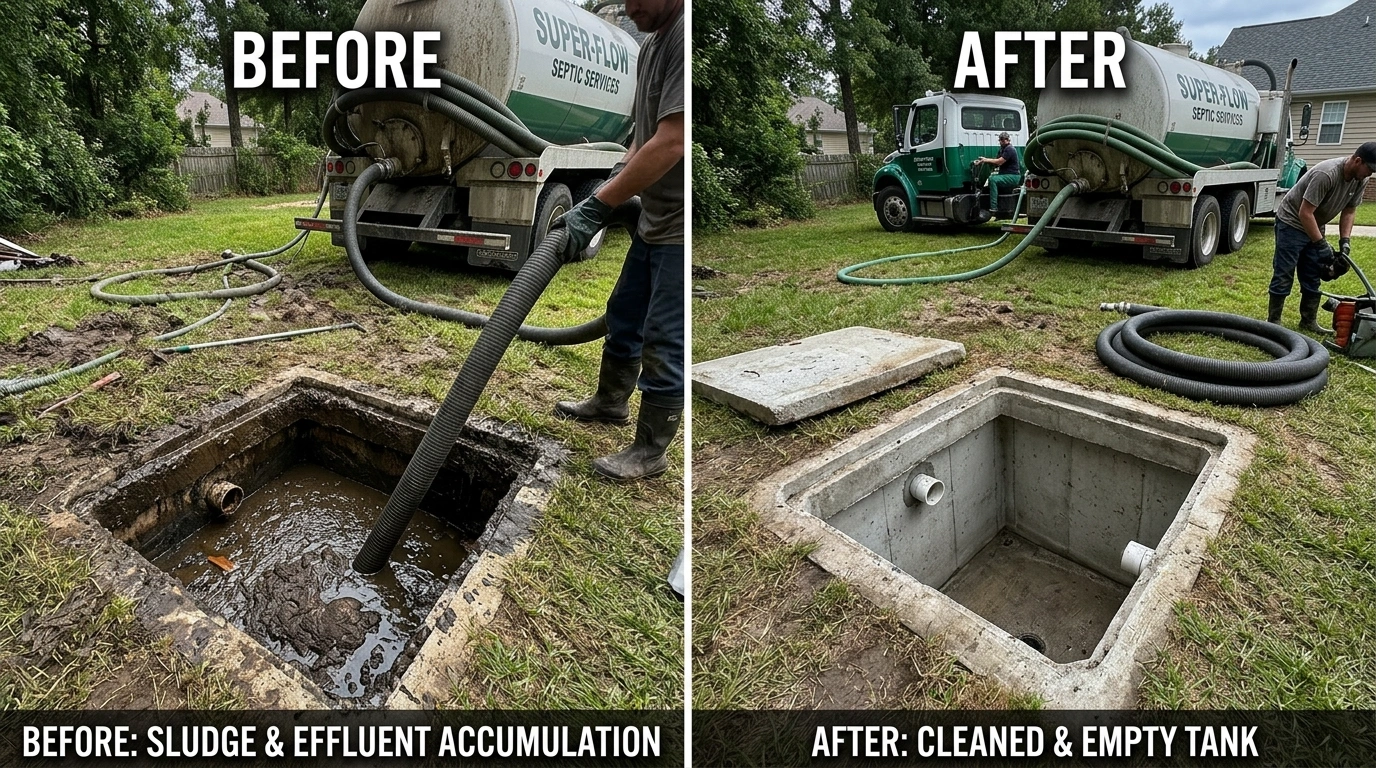
Before: A Johns Island single-family home with a 1,500-gallon concrete septic tank that had not been pumped in over seven years — sewage odors throughout the home's lower level, multiple slow drains, and a persistently wet area developing directly above the drain field indicating early-stage biomat formation.
After: Complete three-layer tank pumping removing over 400 gallons of accumulated sludge, both baffles inspected and outlet baffle replaced, effluent filter cleaned and reinstalled, drain field area assessed and documented — system returned to full operational status with a 3-year pumping schedule established and documented for the homeowner's records.
Before: A West Ashley landlord with a rental property experiencing active sewage backup into a ground-floor bathroom after heavy rainfall — tenants displaced, habitability concerns raised, and the property management team unable to reach a septic contractor until the following week.
After: Fort Charle Plumbing dispatched within two hours of the emergency call, tank pumped completely, inlet baffle found partially collapsed and immediately replaced, system returned to service same day — tenants returned to the property that evening with full documentation provided to the property management company.
Before: A Wadmalaw Island rural commercial property — a small farm-to-table restaurant — with a large-capacity commercial septic system showing high-water alarm activations, slow-clearing drain cycles, and a pump tank that had not been inspected or serviced in four years.
After: Commercial pump tank pumped and cleaned, effluent pump tested and found to be operating below rated output, pump replaced with a properly sized unit, float settings adjusted, alarm system tested and verified — restaurant returned to full commercial operation the same day with a complete commercial service report provided for the owner's DHEC compliance records.
Every septic tank cleaning and pumping service performed by Fort Charle Plumbing uses professional-grade vacuum pumping equipment, inspection tools, and replacement components — and complies fully with South Carolina DHEC regulations, Charleston County permit requirements, and all applicable environmental protection standards for onsite wastewater system service. We do not use undersized pumping equipment that leaves accumulated sludge behind, and we do not skip the inspection and documentation steps that make professional septic service genuinely protective rather than merely superficially functional.
Professional-capacity vacuum trucks and portable vacuum pumping units sized for residential and commercial septic tank volumes — capable of complete three-layer removal from tanks of all standard and large-capacity configurations.
Sanitary tee baffles and formed baffles in PVC, concrete, and fiberglass configurations — selected to match your tank's existing inlet and outlet design and sized for your system's designed flow rates.
Zoeller, Polylok, and Infiltrator effluent filter cartridges compatible with all major filter housing brands installed in Charleston County septic systems — cleaned at every service visit and replaced when cartridge condition warrants.
Zoeller, Liberty, and Goulds effluent pump units for pump-to-field system replacement — sized to match system design specifications and DHEC permitted flow rates.
Concrete and polyethylene distribution boxes and outlet inserts for equal flow distribution repair and replacement — DHEC-compliant installation at proper grade and elevation.
Polyethylene and concrete access riser sections for bringing buried tank lids to grade level — dramatically simplifies future pumping access and reduces service costs over the life of the system.
Visual inspection, soil probe evaluation, and dye testing for early identification of drain field stress, effluent surfacing, and biomat development.
All required South Carolina DHEC service records, pumping manifests, and component repair documentation — completed and provided to the property owner at the conclusion of every service visit.
Determining whether a failing septic system can be repaired or must be fully replaced is one of the most significant and consequential decisions a Charleston property owner can face. Septic system replacement is a major construction project involving DHEC permitting, soil evaluation, system design, and installation costs that typically range from $10,000 to $30,000 or more depending on system type and site conditions. The goal of every Fort Charle Plumbing septic assessment is to give you an honest, evidence-based evaluation of what your system actually needs — never recommending full replacement when targeted repair will restore reliable function, and never recommending continued repair investment when system condition makes full replacement the only sound long-term path.
| Option | What It Is | Key Pros | Key Cons |
|---|---|---|---|
| Targeted Septic Repair | Replacement of specific failed components — baffles, effluent filter, pump, distribution box, access lids | Lower immediate cost; extends system service life; fast turnaround in most cases | Does not address underlying tank age, drain field condition, or system design limitations |
| Partial System Rehabilitation | Multiple component repairs combined with increased pumping frequency and water use management | Addresses multiple failure points; buys time for planned replacement budgeting | Still relies on aging tank and drain field infrastructure; may not achieve full code compliance |
| Full Septic System Replacement | Complete removal of failed tank and drain field, new system design, DHEC permitting, and installation | Full DHEC compliance; maximum remaining service life; full system warranty; best long-term environmental protection | Highest initial investment; requires DHEC permitting and site evaluation; construction disruption |
Most Charleston property owners want a realistic understanding of septic service costs before committing to a service engagement or system repair. Fort Charle Plumbing uses a transparent estimating process that accounts for your tank size, access conditions, lid depth, volume of accumulated solids, and any component repairs identified during the pre-pumping assessment — producing a detailed written estimate that you review and approve before any work begins. The price ranges below reflect typical Charleston County market pricing based on current local labor rates, equipment operating costs, disposal fees, and applicable DHEC documentation requirements.
| Service Type | Typical Charleston Price Range |
|---|---|
| Standard residential septic tank pumping (1,000–1,500 gallon) | $300 – $600 |
| Large residential tank pumping (2,000+ gallon) | $500 – $900 |
| Commercial septic tank pumping | $600 – $2,000+ depending on tank size and volume |
| Outlet baffle replacement | $150 – $400 installed |
| Effluent filter replacement | $100 – $300 installed |
| Distribution box repair or replacement | $300 – $800 installed |
| Effluent pump replacement (pump tank systems) | $500 – $1,500 installed |
| Tank access riser installation (bring lid to grade) | $300 – $700 per riser installed |
| Drain field assessment and dye testing | $200 – $500 |
| Partial drain field repair or line replacement | $2,000 – $8,000 depending on scope |
| Full septic system replacement (residential) | $10,000 – $30,000+ depending on system type and site conditions |
Important Note on DHEC Requirements: Some septic service work in South Carolina — including new system installation, drain field modification, and certain repair scopes — requires a DHEC permit before work begins. Fort Charle Plumbing handles all required DHEC permit applications and inspection scheduling as part of every qualifying project, and all permit fees are disclosed upfront in the written estimate.
Fort Charle Plumbing strongly recommends immediate professional septic service — pumping, repair, or full system evaluation — when any of the following conditions exist at your Charleston County property. These situations represent either active health and safety hazards, environmental compliance obligations under South Carolina law, or circumstances where continued delay will dramatically increase both the cost and the scope of required remediation.
Raw sewage entering bathtubs, floor drains, or any plumbing fixture is a public health emergency requiring immediate professional response; do not use any plumbing fixtures and call Fort Charle Plumbing now.
Effluent appearing on the ground surface represents a direct environmental violation under South Carolina DHEC regulations and a public health hazard — this situation requires same-day professional response and must be reported and remediated.
Charleston's hurricane season creates conditions where otherwise functional systems can fail suddenly; post-storm septic assessment and emergency pumping protects both the property and the surrounding Lowcountry waterways.
Most South Carolina real estate purchase agreements require a current septic inspection and pumping record; a documented, recently serviced system is essential for completing the transaction on schedule.
Before completing a real estate closing on a Charleston property with an existing septic system, a professional inspection and pumping by Fort Charle Plumbing protects you from inheriting an unknown system condition.
Even a well-functioning system that has not been pumped in over five years is likely operating with sludge accumulation levels that are approaching the critical threshold for drain field damage; do not wait for symptoms to appear.
Properties subject to a South Carolina DHEC compliance inspection, violation notice, or mandatory repair order require immediate professional response from a licensed contractor familiar with DHEC documentation and remediation requirements.
Fort Charle Plumbing's commercial septic service capability extends far beyond standard residential pumping. Our 50-person licensed team and 10-van fleet provide the operational capacity to service, pump, and maintain large-capacity commercial septic systems across the full range of rural and commercial property types found throughout Charleston County — from multi-unit apartment complexes and rural rental communities to restaurants, agricultural operations, event venues, campgrounds, rural retail and commercial facilities, and institutional buildings throughout Johns Island, Wadmalaw Island, Edisto Island, Hollywood, and the rural communities of the Charleston County interior. When a commercial septic system fails, the consequences extend far beyond inconvenience — tenant habitability compliance, food service operating permits, DHEC compliance status, and property operational continuity all depend on rapid, professional, fully documented resolution.
| Commercial Service | Details |
|---|---|
| Commercial Tank Emergency Pumping | 24/7 emergency dispatch for septic backups and system failures at multi-unit residential and commercial properties |
| Large-Capacity Tank Pumping | Complete pumping service for high-volume commercial tanks of all sizes and configurations |
| Grease Trap Cleaning & Pumping | Restaurant and food service grease trap service — pumping, cleaning, and DHEC-compliant waste disposal |
| Commercial System Inspection & DHEC Compliance | Charleston County and DHEC commercial permit compliance, inspection scheduling, and full documentation |
| Commercial Preventive Maintenance Programs | Scheduled maintenance contracts for property managers, commercial landlords, and institutional facility operators |
| Pump Station Service & Repair | Inspection, cleaning, and pump replacement for commercial sewage pump stations and lift stations |
| Commercial Drain Field Assessment | Drain field performance evaluation, dye testing, and rehabilitation planning for commercial properties |
| System Capacity Evaluation | Assessment of whether the existing commercial system design can support proposed expansion or increased occupancy |
| Commercial Property Type | Typical Charleston Price Range |
|---|---|
| Small commercial (restaurant, small multi-unit) | $600 – $2,500 per service |
| Mid-size commercial (larger multi-unit, event venue) | $1,500 – $5,000 per service |
| Large commercial (large apartment complex, agricultural facility) | $3,000 – $10,000+ depending on tank capacity and system complexity |
24/7 Commercial Dispatch Available
Professional septic tank service is not simply about removing what has accumulated in the tank — it is about protecting your property's wastewater infrastructure, safeguarding the Lowcountry's fragile coastal environment, maintaining your DHEC compliance status, and preserving the market value of your Charleston home or commercial property. Septic systems involve complex biological treatment processes, regulated environmental discharge, and infrastructure that, when neglected, fails in ways that are both expensive and environmentally damaging. When you hire Fort Charle Plumbing for your septic cleaning and pumping needs, you receive a comprehensive professional service that addresses the full system — not a minimal pump-and-go visit that leaves the system's condition unknown and undocumented.
Regular professional pumping is the single most effective action a property owner can take to protect the drain field from premature biomat failure — the most expensive septic repair in any environment, and especially common in Charleston's challenging Lowcountry soil conditions.
A septic tank pumping every 3 to 5 years often costs far less than a full drain field replacement or complete system rebuild. Preventive maintenance is one of the highest-return investments available to any Charleston property owner.
Professional septic service includes DHEC-compliant waste disposal, pumping manifests, and documentation that unlicensed or DIY pumping cannot legally provide — protecting you from regulatory violations and serious fines in South Carolina.
A documented history of professional septic service is a major advantage in any Charleston County real estate transaction — while an undocumented or recently failed system can delay or derail a sale.
Professional inspection identifies failing baffles, cracked tanks, effluent filter bypass, and early drain field stress that remain invisible without proper evaluation — catching a relatively small repair before it becomes a major system failure.
Charleston's tidal creeks, marshes, and coastal waterways are ecologically irreplaceable. A properly maintained septic system prevents nutrient loading, bacterial contamination, and fecal coliform discharge into the waterways that define the Lowcountry.
Full written service records for DHEC compliance, real estate transactions, insurance documentation, and future service reference — provided at every visit before the technician leaves your property.
If septic issues are affecting your interior drains, Fort Charle Plumbing can also help with drain cleaning, sewer camera inspection, and sewer line repair when needed.
The confined space environment of a septic tank is one of the most immediately life-threatening environments a person can enter without proper training, equipment, and monitoring. Septic tanks contain toxic gases — including hydrogen sulfide (H₂S) and methane (CH₄) — that accumulate in concentrations capable of causing unconsciousness and death within seconds of exposure. Hydrogen sulfide, which smells like rotten eggs at low concentrations, rapidly desensitizes the olfactory nerve at higher concentrations — meaning a person inside or leaning into a septic tank cannot smell danger when it is most acutely present. In Charleston's warm climate, which promotes year-round microbial activity and gas production within septic systems, these risks are present in every tank, every season. Fort Charle Plumbing technicians are equipped with confined space entry equipment, continuous atmospheric monitoring devices, gas detection instruments, and safety protocols that protect both them and your property during every septic service engagement.
Septic tank pumping in Charleston typically costs between $300 and $600 for a standard residential tank in the 1,000 to 1,500-gallon range. Larger tanks, deeply buried lids requiring excavation, tanks with excessive accumulated solids, or locations with difficult vacuum truck access may increase the cost. Fort Charle Plumbing provides a complete written estimate before any service begins — so you always know your exact cost upfront.
The EPA recommends septic tank pumping every 3 to 5 years for a typical household. In Charleston's Lowcountry environment — with its high water table, heavy seasonal rainfall, and challenging soil drainage conditions — we typically recommend 3-year pumping intervals for most properties rather than waiting the full 5 years. Households with garbage disposals, larger families, or systems located near wetlands or tidal areas should consider more frequent service.
The most common signs include slow drains throughout the home, sewage backup into bathtubs or floor drains, persistent sewage odors indoors or outdoors, wet or unusually green patches of grass above the drain field, and gurgling sounds from plumbing fixtures after flushing or draining. If your tank has not been pumped in more than 3 to 5 years, it should be serviced regardless of whether symptoms are present.
Yes — significantly. Charleston's frequent heavy rainfall events, tropical storms, and hurricane-season flooding can temporarily saturate drain field soils, raise the water table above the drain field's effective absorption zone, and overwhelm septic systems that are already approaching their pumping interval. Following any major rainfall event, we recommend a professional septic inspection — especially for properties on Johns Island, Wadmalaw Island, James Island, or in other low-lying areas.
Yes — Fort Charle Plumbing provides true 24/7 emergency septic pumping service throughout Charleston County and the surrounding Lowcountry, 365 days per year including all holidays. Call +1 (843) 483-8585 at any time and a real dispatcher answers immediately. A licensed septic technician is typically en route within 60 to 90 minutes of your call.
The drain field, also called a leach field or soil absorption system, is the underground network of perforated pipes that distributes septic tank effluent into the surrounding soil for final treatment and dispersal. Signs of a failing drain field in Charleston include wet, soggy, or spongy ground above the drain field area, odors outside near the field, unusually lush grass directly over the field lines, and slow drainage throughout the home even after recent tank pumping.
Yes. Fort Charle Plumbing performs professional septic inspections for buyers, sellers, and real estate agents throughout Charleston County. Our inspections include tank pumping, component inspection, drain field assessment, and a comprehensive written report suitable for real estate disclosures, mortgage lender requirements, and home warranty documentation.
Yes — Fort Charle Plumbing provides full commercial plumbing and septic support throughout Charleston County, including large-capacity commercial tank pumping, grease trap cleaning for restaurants and food service operations, pump station service, and commercial DHEC compliance documentation.
Fort Charle Plumbing stands behind every septic tank cleaning and pumping service in Charleston, SC with our complete workmanship guarantee and written documentation of all component repairs and installations performed. When you engage Fort Charle Plumbing for septic service — whether routine scheduled pumping, emergency response, or a comprehensive system inspection — you receive written confirmation of everything we found, everything we did, and everything we recommend, so your investment in your property's wastewater infrastructure is fully supported and completely transparent.
Since 1990, homeowners, landlords, and commercial property owners across Greater Charleston — from the city neighborhoods served by municipal systems to the rural Sea Island communities of Johns Island, Wadmalaw Island, and Edisto Island where private septic systems are the only option — have trusted Fort Charle Plumbing to manage onsite wastewater systems professionally and responsibly.
99 Spring St, Charleston, SC 29403 | Open 24/7 — Every Day of the Year
Every septic tank cleaning, pumping, and repair service performed by Fort Charle Plumbing is executed by technicians holding valid, current South Carolina plumbing and septic service certifications appropriate to the scope of work being performed. When a properly licensed professional services your septic system, your work complies with DHEC regulations, your pumping records are legally valid for real estate and compliance purposes, and your property is protected from the liability exposure that accompanies unlicensed septic work in South Carolina.
Highest South Carolina plumbing credential — authorizes full scope of plumbing and septic system work.
Advanced residential authorization covering all residential septic cleaning, repair, and installation work.
Full South Carolina journey-level authorization for septic service and repair scopes.
State contractor authorization for residential and commercial plumbing and septic contracting.
Specialized residential scope authorization for all residential septic system service and repair.
Full property damage and environmental liability protection on every septic service engagement.
All 50 team members fully covered — no liability exposure to the property owner.
All 10 service vans, including pumping vehicles, fully insured for commercial operation.
All specialized septic pumping and inspection equipment insured against loss or damage.
Coverage for tools and equipment during transport between service locations.
A septic system failure — particularly one causing active sewage backup into the home or effluent surfacing in the yard — is a public health emergency and a potential DHEC regulatory event that cannot wait until the following business day. In Charleston's Lowcountry environment, where heavy rainfall events can overwhelm saturated drain fields within hours and where the area's warm climate makes raw sewage exposure an immediate health risk, rapid professional response is essential. Fort Charle Plumbing operates a genuine 24/7 emergency septic pumping service with live human dispatch at every hour of every day and night.
A live dispatcher answers immediately at any hour — no automated menus, no hold queues, and no next-morning callbacks for active septic emergencies.
The nearest available licensed septic technician and equipped service van are immediately deployed to your property location.
Your technician arrives with assessment tools, locating equipment, and the pumping capacity to address the most common emergency septic situations across Charleston County.
Immediate complete tank pumping to relieve system pressure, stop the backup or overflow event, and restore safe habitation — with component repairs addressed the same visit where possible.
Complete written emergency service record provided before the technician leaves your property — including cause assessment, volumes removed, components repaired, and recommended follow-up actions.
When septic system failure causes property damage — including sewage backup into the home, water damage from overflow, or structural damage to flooring, walls, or finishes from sewage infiltration — your homeowner's insurance policy may cover the resulting property damage. Fort Charle Plumbing provides comprehensive, insurance-grade documentation for every septic emergency we respond to throughout Charleston County, giving you the complete evidence package your insurer needs to evaluate and process your claim efficiently and accurately.
Comprehensive photographic documentation of the failure event, affected fixtures, sewage backup areas, water damage, and structural impact — captured before, during, and after the emergency response.
Detailed written reports describing the specific failure mechanism, the components involved, and the direct relationship between the septic event and the documented property damage.
Itemized service and repair invoices formatted to meet South Carolina insurance carrier documentation standards, including emergency pumping costs, repair costs, and disposal fees.
Complete service records including technician credentials, license numbers, and all required DHEC compliance documentation associated with the emergency response.
Our licensed technicians are prepared to explain technical findings directly to your insurance adjuster in clear, professionally documented language when requested.
DHEC-compliant pumping manifests and disposal records, which many carriers require as part of septic-related claim processing.
Important Note: Standard South Carolina homeowner's insurance policies typically cover sudden and accidental property damage caused by a septic system failure event, such as sewage backup damage to flooring and walls, but generally do not cover the cost of septic system repair or replacement due to wear or deferred maintenance. Our documentation clearly distinguishes acute failure from gradual deterioration.
Every septic service engagement completed by Fort Charle Plumbing comes with clearly written, fully explained warranty documentation — so you know exactly what is covered, for how long, and what process to follow if any issue related to our work arises within the warranty period. We believe in complete transparency because we are confident in the quality of our workmanship and in the durability of every component we install.
| Coverage Type | What's Covered | Typical Term |
|---|---|---|
| Workmanship Warranty | All labor performed by Fort Charle Plumbing licensed septic technicians | 1 year on repair and component installation work |
| Outlet Baffle Replacement Warranty | Parts and installation labor | 1 year on labor; manufacturer warranty on baffle component |
| Effluent Filter Warranty | Filter cartridge and installation | 1 year on labor; manufacturer warranty on filter housing and cartridge |
| Effluent Pump Replacement Warranty | Zoeller, Liberty, and Goulds pump units and installation | 1–3 years depending on model; manufacturer warranty on pump unit |
| Distribution Box Warranty | Replacement box, outlet inserts, and installation | 1 year on labor; manufacturer warranty on box and components |
| Access Riser Installation Warranty | Riser sections, lid, and installation workmanship | 1 year on labor; manufacturer warranty on riser components |
Effective septic tank pumping and inspection requires purpose-built professional equipment — not improvised consumer-grade tools or undersized vacuum capacity that leaves accumulated sludge behind and produces an incomplete service result. Fort Charle Plumbing maintains a fleet of 10 fully equipped service vehicles deployed throughout Charleston County and the surrounding Lowcountry, each carrying the pumping capacity, inspection tools, and component repair inventory needed to service the full range of septic system types encountered across Charleston's diverse residential and rural property landscape.
Strategically positioned throughout Greater Charleston and the Lowcountry for maximum coverage across Johns Island, Wadmalaw Island, Hollywood, Edisto Island, and nearby service cities.
High-capacity vacuum equipment capable of complete three-layer removal from residential and commercial septic tanks of all standard sizes — no partial pumping and no sludge left behind.
Tank locating equipment, soil probes, atmospheric gas monitors, inspection mirrors, dye testing supplies, and documentation cameras for complete service reporting.
Outlet baffles, effluent filters, access riser sections, pump float assemblies, and distribution box outlet inserts — enabling first-visit repairs for common failures.
Ensures the nearest certified technician reaches your Charleston property in the shortest possible time — especially important after storms or during peak demand.
Full Commercial Auto Insurance coverage on every vehicle including pumping equipment transport vehicles.
A complete septic system repair or full replacement represents one of the most significant unplanned expenditures a Charleston homeowner can face. We understand that absorbing this cost all at once — especially when a septic emergency arrives without warning — can be challenging. That is why Fort Charle Plumbing offers flexible financing options that allow qualified property owners to address necessary septic repairs and system upgrades immediately, without compromising on the quality of the work or the system components installed.
Choosing a septic tank cleaning and pumping company in Charleston should be straightforward when independent credentials and third-party recognition make the choice clear. Fort Charle Plumbing has earned multiple industry and community awards that recognize consistent technical excellence, superior customer service, and meaningful contributions to the Charleston business community over more than three decades of operation.
| Award | Issuing Organization | What It Recognizes |
|---|---|---|
| Charleston's Choice Award — Best Plumber | Charleston community vote | Consumer-voted recognition for outstanding plumbing and septic service quality in the Charleston market. |
| Best of South Carolina — Plumbing Contractors | South Carolina industry recognition | Statewide recognition for plumbing and septic contractor excellence across South Carolina. |
| Quality Business Award — Best Water Purification & Plumbing | Quality Business Association | Excellence in plumbing, water quality, and environmental service delivery. |
| SC Best in Business Awards — Plumbing Company | South Carolina business community | Recognition for outstanding business performance and service quality in the plumbing and septic sector. |
| Super Service Award | Angi | Consistent top-tier customer ratings and verified service excellence across the platform. |
Fort Charle Plumbing is proud to offer meaningful discounts to the community members who have contributed the most — Charleston's senior citizens and our military veterans and their families. Many of Charleston County's rural homeowners on fixed incomes rely on private septic systems that require regular professional maintenance, and we believe cost should never become a barrier to safe wastewater management.
Available to Charleston-area homeowners aged 65 and older on residential septic tank pumping, inspection, or repair service performed by Fort Charle Plumbing.
Available to active-duty military personnel, veterans of any branch, and immediate family members on septic services provided throughout Charleston County and the Lowcountry.
Fort Charle Plumbing periodically offers promotional pricing on scheduled septic pumping services — ask about current specials when you call.
Ask about combining septic pumping with related services such as drain cleaning, water line inspection, or other plumbing work for combined visit efficiency.
Mention your discount when you call: +1 (843) 483-8585. Discounts may not be combined with each other but may often be combined with financing programs. Full eligibility terms are available from our dispatch team.
Unlike many Charleston-area septic companies that operate on restricted weekday schedules and charge significant premium rates for evening, weekend, or holiday emergency calls, Fort Charle Plumbing maintains a true 24/7/365 operating schedule with no after-hours surcharge for emergency dispatch at any time.
| Day | Hours |
|---|---|
| Monday | 12:00 AM – 11:59 PM (24 Hours) |
| Tuesday | 12:00 AM – 11:59 PM (24 Hours) |
| Wednesday | 12:00 AM – 11:59 PM (24 Hours) |
| Thursday | 12:00 AM – 11:59 PM (24 Hours) |
| Friday | 12:00 AM – 11:59 PM (24 Hours) |
| Saturday | 12:00 AM – 11:59 PM (24 Hours) |
| Sunday | 12:00 AM – 11:59 PM (24 Hours) |
| Emergency Service | Available 24/7 — 365 days per year including all federal, state, and local holidays |
Charleston County has several septic tank cleaning and pumping contractors to choose from — and the differences between them are significant when your onsite wastewater system has failed, DHEC compliance is at stake, or a real estate transaction depends on a professionally documented service record. When you need a septic contractor in Charleston, you need a company with the equipment capacity to pump thoroughly, the licensing credentials to produce legally valid DHEC documentation, the regional knowledge to understand your specific Lowcountry site conditions, and the professional integrity to price honestly and stand behind their work.
| What Matters | Fort Charle Plumbing | Typical Smaller Charleston Competitors |
|---|---|---|
| Team Size | 50 licensed professionals | 2–6 technicians; often significant scheduling delays after storm events |
| Fleet Size | 10 fully equipped service vehicles | 1–2 trucks; limited capacity during peak demand |
| Years in Charleston | 30+ years (established 1990) | Often under 10 years with limited local regulatory familiarity |
| Verified Reviews | 4.9★ from 6,347 verified customers | Typically far fewer reviews with less consistency |
| Licensing Level | Master Plumber + Master Residential + Journeyman + Specialty Contractor | Often lower-level or limited specialty authorization |
| Emergency Response | True 24/7 live dispatch — no after-hours surcharge | After-hours and weekend surcharges are common |
| DHEC Documentation | Complete DHEC-compliant pumping manifests and service records provided at every visit | Often minimal or informal documentation not meeting DHEC standards |
| Estimate Documentation | Complete written, itemized estimates before work begins | Often verbal quotes only with no written confirmation |
| Insurance Coverage | Full CGL + Workers' Comp + Commercial Auto + Tools & Equipment + Inland Marine | Often minimum required coverage only |
| Industry Awards | Multiple independently issued awards | Few or none with verifiable third-party recognition |
Do not wait for a developing septic situation to escalate into a health emergency, a DHEC compliance violation, or a real estate transaction obstacle. Whether you need same-day emergency septic pumping, a pre-sale system inspection and written report, a scheduled routine cleaning at your recommended interval, or a full assessment of a system that has not been serviced in years, the Fort Charle Plumbing team is ready to respond right now. Our dispatchers are live at every hour of every day.
Send your details and our Charleston septic team will respond quickly.